offer strengths that make them preferable to pressure transmitters or electronic models in a range of applications: mechanical pressure switches address needs that differ from those met by electronic instruments

Mechanical Pressure Switches

SUCO Mechanical Pressure Switches
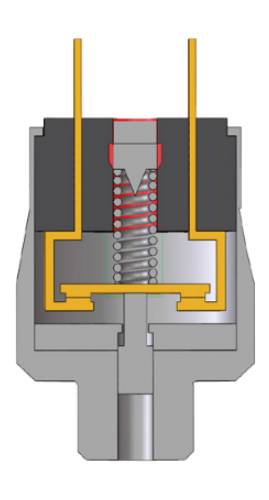
SPST NC Pressure Switch
SUCO hex 24
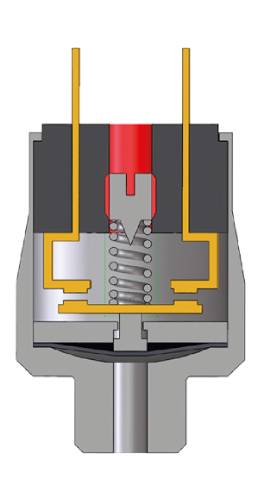
SPST NO Pressure Switch
SUCO hex 24
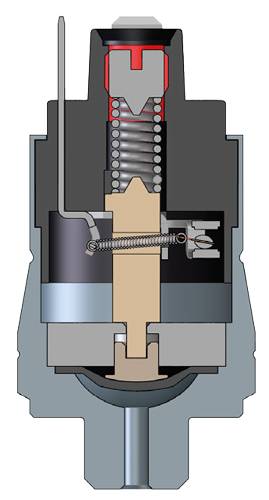
SPDT NC Pressure Switch
SUCO hex 27
Fail-safe reliability and functional simplicity
A mechanical pressure switch operates on a direct physical principle: pressure acts on a moving element (a piston or plunger) that opposes a calibrated spring. When the set point is reached, the movement mechanically actuates a microswitch.
- power-supply independence: unlike pressure transmitters and electronic pressure switches, it does not require power to monitor pressure and can interrupt a circuit even in the event of a total blackout of the control system (also applicable to the self-diagnostic systems of the PLUS series)
- intrinsic robustness: because it contains no electronic components, it is not affected by voltage fluctuations, electromagnetic interference (EMI), or electrostatic discharge
Direct switching capability (power switching)
This is one of the most significant technical advantages: a mechanical pressure switch can switch substantial electrical loads directly through its contacts. A pressure transmitter only sends a signal (4–20 mA or 0–10 V), which requires a PLC and an external relay to act on a load such as a pump or valve. In many scenarios, a mechanical pressure switch can therefore be considered both a sensor and a switch in a single component.
The advantage of a spring versus the full-scale limit
In mechanical pressure switches, adjustment is achieved through the preload of a spring that opposes the force exerted by the fluid on a piston or diaphragm. Because the switch only needs to “trip” at a threshold, the mechanics can be calibrated with extreme sensitivity. If a pressure switch is designed to withstand 600 bar but has a finely adjustable spring, it can still provide a set point of 0.1 or 0.3 bar
The accuracy of pressure transmitters and electronic pressure switches is almost always expressed as a percentage of full scale (FS), typically from 0.25% to 1% FS. If a 600 bar transmitter is used to monitor a critical variation at 10 bar, an error of 0.25% FS corresponds to ±1.5 bar. This makes it impossible to distinguish a 0.1 bar variation, because the signal “noise” or instrument uncertainty is greater than the variation you want to detect
BRIEF COMPARATIVE ANALYSIS: WHEN AND WHY CHOOSE A MECHANICAL PRESSURE SWITCH?
| Feature | Mechanical Pressure Switch | Pressure Transmitter / Electronic Pressure Switch |
| Cost | Low (device + simple installation) | High (requires complex wiring and a PLC) |
| Maintenance | Visual and functional, highly intuitive | Requires software diagnostic tools |
| Safety (SIL) | Excellent for hardware interlock functions | Requires costly electronic redundancy |
| Accuracy | Moderate (fixed or adjustable hysteresis) | High (continuous, linear reading) |
| Operating pressure vs. accuracy | Excellent: adjustment down to 0.1 bar is possible even with a maximum pressure of 600 bar | Limited: you must use an instrument suited to the operating pressure, often at the expense of accuracy |
| Power consumption | None | Requires power, which may sometimes be limited |
| Temperature compensation | Not possible | Not possible |
Contact us to find out if your application requires a mechanical pressure switch or vacuum switch and to identify the optimal solution with us.