page-header

ROPEX IMPULSE SEALING

ROPEX sealing systems: the high-dynamic closed loop that makes the difference

THE REVOLUTION IN PLASTIC FILM SEALING: OVERCOMING THE LIMITS OF CONVENTIONAL TECHNOLOGIES.

As is well known, the heat sealing of plastic films relies on the control and adjustment of three quantities:

  • time
  • pressure
  • temperature

Of these three, temperature has been the most critical factor in achieving efficient and effective control and regulation. Historically, the sealing of plastic films first relied on hot bar systems: simple metal masses heated by cartridge resistors.

While the hot bar was a starting point, it quickly became a limitation greater effciency. What was its primary flaw? The temperature not completely under control, the thermal drift, the inability to cool the fillm with closed bars. The result: a lot of waste and potentially unstable processes.

Time-based systems: from the inertia of the hot bar to the first rudimentary “heat pulse”

To address this obstacle, early 50s of the last century, systems using the heating element (resistive heater), consisting of a thin metal strip with reduced thermal mass, were introduced. These systems, controlled by a simple timer and a rheostat
to control the power, partially eliminate the problems of the hot bar: the cooling of the film with closed bars allows it to stabilize the plastic film, avoiding elongation, defects in tightness and optical quality.

However, the control is still approximate and is based on an estimate of the temperature/time combination and not on the actual temperature, always leaving inaccuracies at the mercy of inaccuracies and making commissioning time-consuming and expensive. The use of temperature sensors, PID and artifcial intelligence to reduce weaknesses are a palliative, but they do not solve the underlying problem: process control and regulation are not dynamic and precise enough in the presence of high speeds, critical films and are difficult to set up.

These systems are commonly referred to as “impulse sealing” or “pulse sealing”,referring to the fact that they can be switched on and off in much faster intervals than the hot bar.
To be completely right, the most correct definition is time-based sealing systems
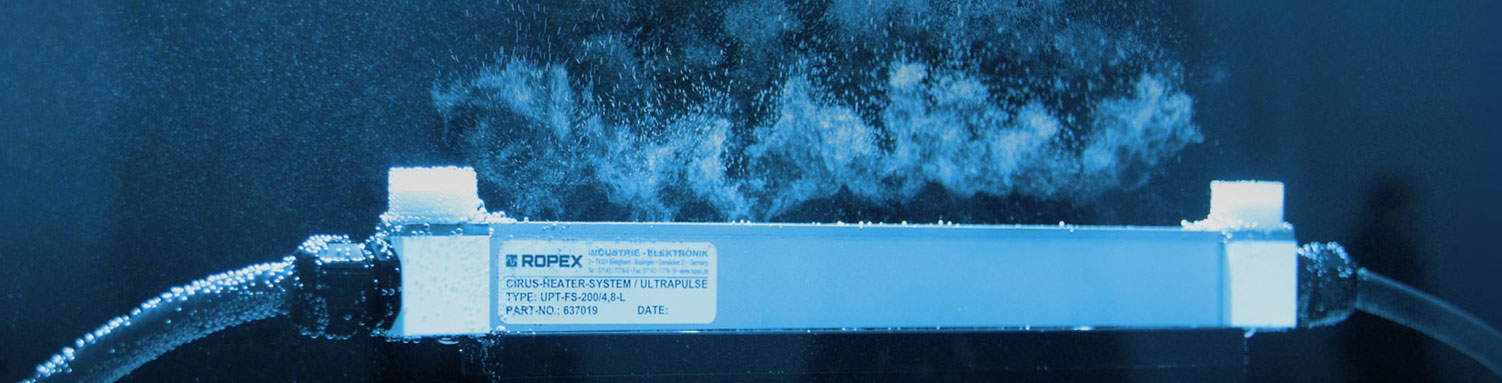
ROPEX Innovation: the technology that allows real time control and adjustment of the sealing process

In 1980 ROPEX present a r the market by proposing the RESISTRON closed-loop and high dynamic impulse sealing systems. These meet the need for real-time and reliable control of the sealing process. In practice, the system uses the heating element (resistive heater) as a temperature sensor and self-regulates at a frequency of 50 Hz. The ROPEX self-sensing technology was born!

The state-of-the-art impulse sealing concept

It is no longer a question of providing “a certain temperature for a certain period”,empirically seeking a more or less stable equilibrium while ignoring the boundary conditions: with the ROPEX system, a train of power pulses is managed at the mains frequency, partializing them if and when it is necessary. This adjustment is made through a calculation based on the current, voltage and coeffcient of variation of the resistance of the sealing element by its temperature (so-called TCR).

The ROPEX system can therefore be defined as “power pulses that generate controlled and measured heat pulses in real time with high dynamics and perfect repeatability”.

Overcoming the cultural gap opens up new horizons: think about ROPEX!

Understanding the model on which ROPEX technology is based opens up new perspectives, reduces TCO (total cost of ownership), expands the range of sealable materials (monomaterial, ecoplastics) with excellent results and increases environmental sustainability. No magic formula, but a brilliant technical idea constantly developed according to the needs of packaging and its evolution.

This technology has several advantages over previous ones:

  • low thermal mass:
    • virtually no heat transfer to the packaging contents
    • minimized thermal inertia
    • negligible thermal drift
  • highly dynamic cooling and heating (“continuous” control and regulation at the mains frequency)
  • reduced uncertainty about process parameters
  • temperature detection even during closed bar cooling
  • excellent repeatability
  • tools with IP65 protection (CIRUS only)
  • you could avoid the teEon cover strip on the sealing tool
  • reduced commissioning and maintenance times
Back to top of page