Electronic pressure switches overcome some of the physical limitations of mechanical devices and are better suited to complex process control. They also solve certain issues that can arise when mechanical pressure switches are used. They are not a better solution—simply a different one, designed to meet different needs

ELECTRONIC PRESSURE SWITCHES
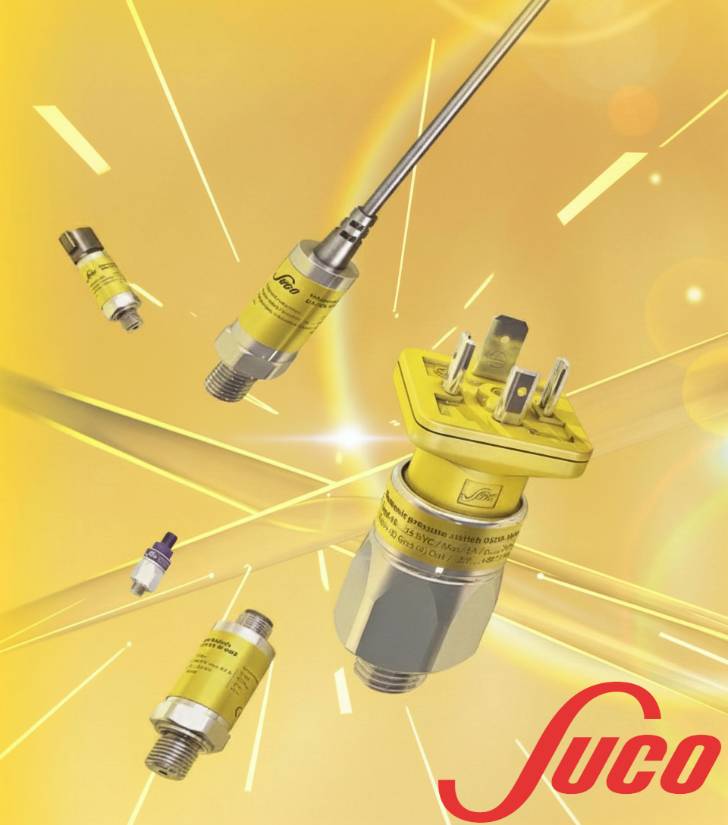
SUCO Electronic Pressure Switches
LONG-TERM PERFORMANCE AND FUNCTIONAL STABILITY
At the heart of a SUCO electronic pressure switch is either a ceramic measuring cell or a SoS (Silicon-on-Sapphire) sensor, both free of moving mechanical parts subject to wear
- extended service life: whereas a mechanical model has a useful life defined by spring elasticity and contact wear (typically 1–2 million cycles), electronic pressure switches guarantee tens of millions of switching cycles without any degradation in performance
- Resistance to stress: the absence of moving parts makes these devices exceptionally resistant to vibration, shock, and high acceleration, eliminating the risk of false contacts (so-called “contact bouncing”)
TOTAL FLEXIBILITY: PROGRAMMABLE HYSTERESIS AND SWITCHING THRESHOLDS
The biggest limitation of mechanical devices is rigidity: hysteresis is fixed or adjustable only within a narrow range. With electronics, control is total. Using the integrated buttons or software programming, you can define both the switching point and the reset point precisely. This makes it possible to create more advanced logic, such as window functions (activation only within a specific range) or switching delays to prevent transient pressure spikes from triggering unwanted alarms.
2-IN-1 FUNCTIONALITY: MONITORING AND ACTUATION
SUCO electronic pressure switches offer dual functionality in a single compact housing:
- switching output (PNP/NPN): to actuate directly, or via PLC, like a conventional pressure switch.
- analogue output: to send a continuous reading of the pressure trend, combining sensor and switch in a single device.
VISUAL DIAGNOSTICS AND USER INTERFACE
Electronic pressure switches can be equipped with displays and LEDs, allowing the operator to read the pressure directly on the machine without additional gauges, check whether the output is active, and detect any system errors.
Contact us to find out if your application needs an electronic pressure switch and to identify the optimal solution with us.